
Beloved wives and data centres
A Fallen Petals post

Your first time reading this series?
The series, A Million Fallen Petals, is a slow, attentive practice rather than a ranking or review. Each post pauses over a small handful of haiku or senryu that caught my eye on Bluesky— to notice how they work, where they open, and what they trust the reader to carry. The aim is to practise seeing: to linger with a few petals instead of trying to gather the whole tree, and to share what careful attention reveals.
Here’s this week’s fare:
First up we have a poet new to the stack, Steve Ullom, with a clever senryu:
This senryu is an excellent example of contemporary social commentary built around layered language rather than overt argument. It addresses a very current issue—the proliferation of data centres—but does so through a simple phrase that subtly accumulates meanings. The poem’s wit lies in the fact that its title image can be read simultaneously as physical process, emotional response, and political sentiment.
The opening phrase, “cooling off,” is deceptively rich. In everyday speech, it suggests tempers settling, enthusiasm fading, or relationships becoming less intense. It also immediately evokes the immense cooling systems that modern data centres require to dissipate the enormous quantities of heat generated by their servers. Before the poem even reaches its subject, it has already established an ambiguity between metaphorical and literal cooling.
The following lines, “all the towns saying no / to data centers,” resolve that ambiguity while opening new ones. On the surface, this is a straightforward observation about communities resisting new developments. Increasingly, towns around the world are pushing back against proposed data centres because of concerns over energy consumption, water use, noise, environmental impact, and changes to local character. The poem captures this emerging social phenomenon without editorialising.
What makes the senryu particularly satisfying is the way “cooling off” continues to reverberate after the final line. The towns are “cooling off” on the promises of technological progress. The enthusiasm surrounding AI infrastructure, cloud computing, and digital expansion is no longer unquestioned. At the same time, the phrase recalls the literal cooling that these facilities require in order to function. The poem therefore creates a neat inversion: communities are cooling towards technologies that themselves cannot operate without enormous cooling systems.
This interplay between figurative and literal meanings gives the poem much of its depth. It also introduces an ironic contrast between the rhetoric surrounding data centres and their physical reality. They are often presented as clean, almost immaterial symbols of the digital economy—places where information simply “lives in the cloud.” Yet the poem quietly reminds us that they are intensely physical infrastructures, consuming land, electricity, and water while producing substantial amounts of heat. The metaphorical “heat” of technological hype is mirrored by the literal heat generated by the machines themselves.
The humour is understated but effective. There is a dry satisfaction in watching a common idiom acquire a second, entirely different meaning through context. That kind of linguistic play is a hallmark of good senryu, where wit emerges from observation rather than from punchlines.
The poem also demonstrates how senryu can engage with contemporary issues without becoming polemical. It does not tell the reader whether towns are right or wrong to reject data centres. Instead, it simply observes a cultural shift. The poem’s subject is less the technology itself than the changing human response to it.
One of the poem’s strengths is that it will likely remain intelligible even as the specific debate evolves. Communities have always negotiated the costs and benefits of new infrastructure, whether railways, factories, wind farms, or transmission lines. Data centres are simply the latest expression of that tension. By focusing on the human act of “saying no,” the poem speaks to a recurring pattern of technological adoption and resistance.
If there is one small reservation, it is that “all the towns” is intentionally broad. It functions rhetorically rather than literally, since not every town is resisting such developments. Some readers may find the generalisation slightly sweeping. However, in the compressed language of senryu, this breadth also gives the poem a communal voice, suggesting a growing mood rather than making a statistical claim.
Overall, this is a clever and timely senryu that succeeds through layered wordplay rather than explicit commentary. The opening phrase, “cooling off,” simultaneously evokes declining enthusiasm for the data centre boom and the immense cooling demands of the facilities themselves. In doing so, the poem captures both the cultural and physical realities of our digital age. It is a small poem with a surprisingly large reach, demonstrating how a single well-chosen phrase can illuminate the intersection of language, technology, and public sentiment.
Next we have another new poet, if my memory serves, with Barico:
This is a delightful short poem that combines understated humour with genuine observation. While it is framed by a seasonal image, its real subject is not the sunset but the speaker’s moment of self-recognition. For that reason, although it could comfortably be presented as a haiku, it feels more at home as a senryu, where the natural world serves to illuminate a distinctly human experience.
The opening phrase, “summer sunset,” immediately establishes atmosphere. Summer evenings encourage lingering outdoors, when the low angle of the sun casts long, exaggerated shadows across the ground. It is an image rich in warmth and tranquillity, preparing the reader for a contemplative rather than dramatic moment.
The following lines, “my shadow shows me / a new tai chi move,” provide an unexpected and charming turn. At first glance, the humour lies in the idea that the shadow becomes the teacher. The speaker is not inventing a movement but discovering one through the accidental distortions of light and perspective. Shadows often appear to move independently of us, stretching, bending, and elongating in ways that make familiar gestures seem unfamiliar. The poem captures that playful illusion beautifully.
The choice of tai chi is particularly apt. Tai chi is characterised by slow, flowing, meditative movements that already resemble a kind of moving shadow. Because its forms emphasise balance, awareness, and harmony with one’s surroundings, the image of learning from a shadow feels entirely natural rather than whimsical. Had the poem referred to another activity—boxing or tennis, for example—the effect would have been quite different. Tai chi allows the physical phenomenon and the philosophical resonance to reinforce one another.
There is also a subtle suggestion that nature remains a teacher. The speaker does not consciously set out to learn anything. Instead, the low summer sun creates a fleeting perspective in which the ordinary body becomes unfamiliar. The shadow reveals possibilities that the conscious mind had not noticed. In this sense, the poem celebrates openness to chance and the value of paying attention.
This interplay between perception and self-awareness is where the poem leans towards senryu. The real revelation is not about summer or sunset but about the speaker’s amused relationship with themselves. The natural setting provides the conditions for the insight, but the poem’s emotional centre lies in human perception and the capacity to find delight in everyday accidents.
That said, this is precisely the sort of poem that demonstrates how porous the boundary between haiku and senryu can be. Remove the seasonal setting and it becomes unmistakably senryu. Remove the human response and only a beautiful sunset remains. The poem depends equally on both. The sunset is not decorative; without the low summer light there would be no elongated shadow and therefore no “new tai chi move.” Nature and human experience are inseparable here.
The personification of the shadow is handled with admirable restraint. It “shows” the speaker a movement rather than acting as an independent character. This light touch preserves the playful tone without tipping into fantasy. Readers readily accept the conceit because anyone who has watched their own shadow can recognise the experience of seeing familiar actions transformed by changing light.
There is also an appealing philosophy beneath the humour. Tai chi encourages adaptability, attentiveness, and learning from the flow of the moment. The poem itself enacts those values. The speaker discovers something unexpected not through effort but through observation. Whether the “new move” is practical or purely imaginary is beside the point. What matters is the moment of joyful recognition.
Overall, this is an engaging and subtly wise poem. It combines a seasonal landscape with a distinctly human moment of playful self-discovery, making it a convincing example of the fertile overlap between haiku and senryu. If labelled as senryu, it would sit comfortably among poems that explore human nature through everyday experience. If labelled as haiku, it would still succeed because the natural world is not merely a backdrop but an active participant in the poem’s unfolding. Ultimately, the poem reminds us that paying attention—to light, to movement, and even to our own shadows—can turn an ordinary summer evening into a small lesson in awareness.
Next is Asura whose translations appear so regularly here, that I have considered creating a separate post. It’s another Shinko Tokizane senryu:
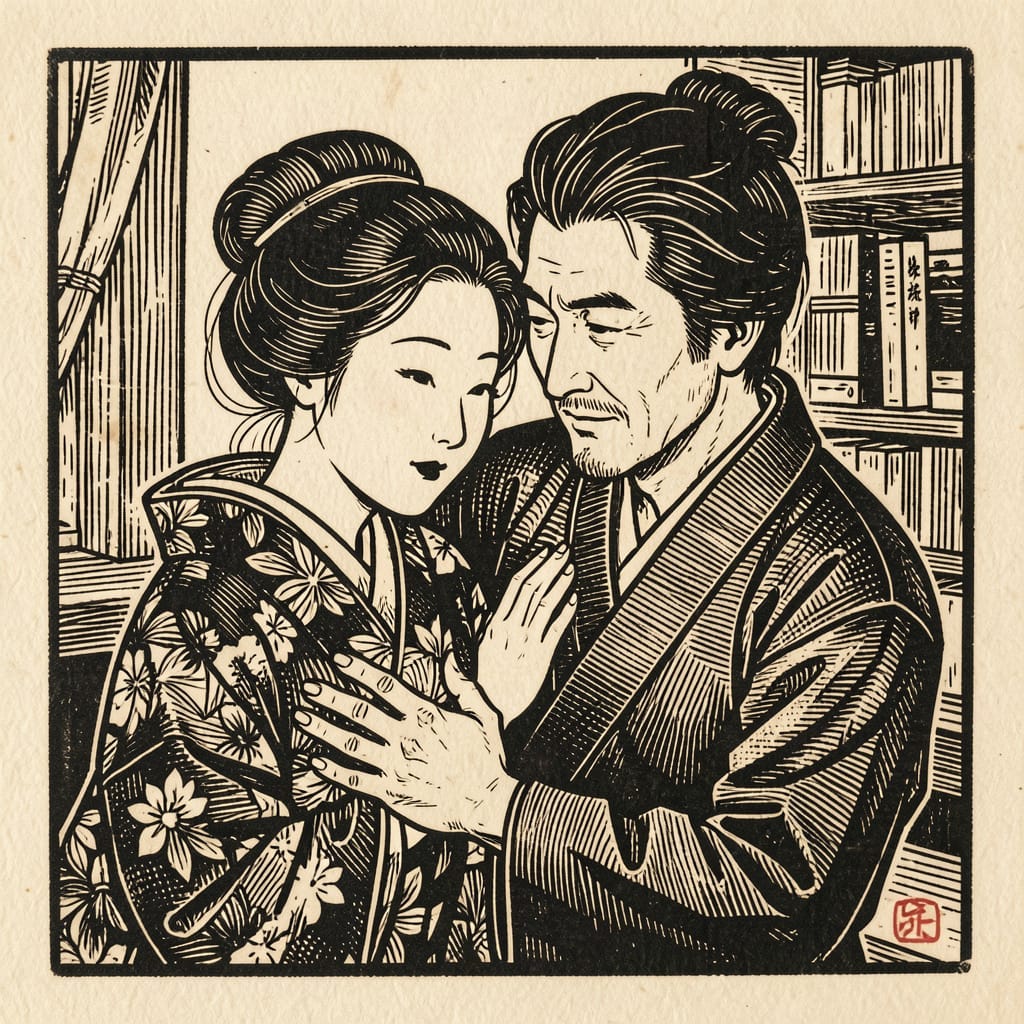
This senryu is devastating. Its language is deceptively simple, yet beneath it lies a profound meditation on love, memory, and the cultural narratives that shape expectations of women. Whether or not the reader recognises the specific reference that Asura mentions above, the poem works as a reflection on the distance between idealised stories and lived reality. Knowledge of the likely allusion, however, deepens its resonance considerably.
The opening phrase, “story of a beloved wife,” immediately signals that the speaker is reading a narrative rather than directly experiencing events. The wording is significant. “Beloved wife” evokes an ideal rather than an individual, suggesting not merely affection but a culturally sanctioned role. Even before the poem reaches its conclusion, there is a sense that the wife belongs to a familiar archetype rather than an ordinary human life.
The second line, “I finish reading,” is almost matter-of-fact. It acts as a hinge between the external text and the speaker’s internal response. There is no emotional description, no explanation of what has been read. Instead, the poem moves directly to its startling final perception.
“As though it were a myth.”
This final line transforms the entire poem. At first, “myth” appears to refer simply to the fictional nature of the story. But myths are not merely false stories; they are narratives that embody cultural ideals, values, and expectations. The poem therefore raises a subtle but unsettling question: is the beloved wife mythical because the story is fictional, or because such self-sacrificing devotion has itself become unbelievable?
If Asura is correct that the poem alludes to the 1951 film Story of a Beloved Wife, the irony becomes even sharper. In that film, the wife supports her struggling husband through relentless self-sacrifice, only to die of tuberculosis just as his success arrives. The narrative embodies a familiar post-war Japanese ideal of feminine virtue: the wife whose devotion is measured by her willingness to endure hardship and efface herself for her husband’s sake.
Read in that context, the final line becomes quietly subversive. The speaker does not respond with admiration or nostalgia. Instead, the story is experienced “as though it were a myth.” The implication is that such ideals no longer feel real, or perhaps never truly were. The poem gently questions the cultural script that celebrates women whose lives are defined entirely by sacrifice.
At the same time, the poem avoids becoming a straightforward critique. “Myth” is an exquisitely ambiguous word. Myths are culturally powerful regardless of their factual truth. They shape behaviour, aspirations, and identities. The poem therefore acknowledges the enduring influence of the ideal even while suggesting its distance from contemporary experience.
This ambiguity is characteristic of Shinko Tokizane’s work that I have read. Rather than declaring a position, Tokizane often allows irony to emerge through understatement. Here, the emotional restraint is remarkable. The poem contains no explicit judgement of the wife, the husband, or the story itself. Everything depends on the force of the closing comparison.
The senryu also speaks beyond its immediate cultural context. Every society constructs myths about ideal partners, ideal parents, and ideal citizens. Readers unfamiliar with Japanese history can still recognise the experience of encountering narratives whose moral expectations feel increasingly remote from modern life. In this sense, the poem is not only about Japanese womanhood but about the changing relationship between inherited ideals and lived reality.
There is another possible layer as well. The phrase “as though it were a myth” may express not scepticism but grief. Perhaps the speaker longs to believe such devotion exists but finds it impossible. The line can therefore be read as both critique and lament. The loss is not simply of a particular model of marriage but of faith in uncomplicated ideals altogether.
Overall, this is a subtle and sophisticated senryu that achieves its power through understatement rather than polemic. Its likely allusion to Story of a Beloved Wife enriches the reading, transforming what appears to be a simple response to a book or film into a meditation on cultural myth-making and the idealisation of feminine sacrifice. Yet even without that knowledge, the poem remains compelling. It asks what happens when the stories a culture tells about love and devotion become so distant from lived experience that they begin to feel less like history than mythology itself.
Next another new poet, Petro. As you can see in the embedded post. This poem was selected by Asura above for inclusion in a feature post on the Haiku Foundation Haiku Commentary. Please click through and read that as well.
This senryu is a sharp and contemporary meditation on loneliness, technology, and the changing relationship between humans and the natural world. Its power comes from the collision of two very different kinds of sound: the organic, unpredictable soundscape of birdsong and the artificial, on-demand recreation of that sound through a digital assistant.
The opening phrase, “another summer,” immediately establishes recurrence. The word “another” is doing considerable work. This is not a single moment of absence but part of an ongoing pattern. Summer traditionally suggests abundance, activity, and life at its fullest, making the following phrase, “of increasing silence,” feel unsettling. The season associated with growth and vitality is instead marked by diminishing sound.
The second line is especially effective because “silence” operates on multiple levels. It may refer literally to fewer birds, perhaps because of habitat loss, climate disruption, declining insect populations, or urbanisation. It may also suggest a more personal silence—the quiet of isolation, ageing, grief, or a world becoming less connected. The poem never specifies which kind of silence is increasing, allowing the environmental and emotional readings to overlap.
The final line, “Alexa, play birdsongs,” provides the poem’s decisive turn. The sudden appearance of a voice command creates a striking contrast with the organic imagery implied by birdsong. The speaker no longer listens to living creatures but requests a simulation of them. A natural experience has become a digital service.
This is where the poem’s irony becomes most powerful. The human desire for birdsong remains, but the relationship has changed. Instead of stepping outside and hearing an unpredictable chorus shaped by weather, season, and place, the speaker summons a curated approximation through technology. The command is both practical and tragic. It reveals adaptation, but also loss.
The choice of “Alexa” is particularly effective because it represents more than a device. It is shorthand for a broader technological relationship in which convenience increasingly mediates experience. The poem is not necessarily anti-technology; after all, the speaker still seeks beauty and connection. Rather, it observes the strange condition of asking technology to provide a substitute for something technology and human activity may be helping to diminish.
As a senryu, the poem is especially successful because its subject is ultimately human behaviour. The focus is not simply on declining birdsong but on how humans respond to absence. The command to Alexa reveals both melancholy and ingenuity: the speaker recognises what is missing and attempts, however imperfectly, to recover it.
There is also a subtle echo of grief in the structure. The first two lines move from broad observation to emotional weight: “another summer” becoming “increasing silence.” The final line then shifts into the language of everyday technology, almost interrupting the melancholy with a mundane instruction. That contrast produces the poem’s sadness. The speaker’s response to ecological loss is reduced to a voice command.
The poem also raises interesting questions about the boundary between haiku and senryu. The presence of summer and birdsong might initially suggest haiku, with its seasonal awareness and attention to nature. However, the central insight concerns human interaction with the natural world and the technological replacement of experience, making it strongly senryu in character. The birdsong is not simply an observed natural phenomenon; it is a symbol of something missing and something humans attempt to recreate.
That said, the poem demonstrates why the distinction can sometimes become artificial. The natural image and the human response are inseparable. The silence exists because of changes in the natural world, but the emotional impact comes from the human attempt to negotiate that absence. It sits in the fertile space where haiku and senryu overlap.
One possible criticism is that “Alexa” is highly contemporary and may date the poem. However, this may also become part of its historical value. Many senryu capture the language and technologies of their moment, and this poem documents a particular early twenty-first-century experience: using artificial intelligence and digital assistants to compensate for increasingly mediated relationships with the world.
Overall, this is a thoughtful and haunting senryu. It transforms a simple voice command into a reflection on ecological change, loneliness, and the paradox of using technology to reconnect with what technology cannot truly replace. The final irony is that the speaker is not asking Alexa for entertainment but for a memory of a living world. The poem leaves us wondering whether the simulated birdsong is a comfort, a warning, or a small elegy for what is disappearing.
And to finish we have Orrin, another regular:
This one-line senryu is a sharp example of how a simple physical sensation can be used to reveal a social and psychological truth. Its humour and insight emerge from the collision between the literal bitterness of a lemon and the figurative bitterness of unspoken thoughts.
“Acidity of a lemon” immediately gives the poem a strong sensory entry point. The reader can almost experience the sourness: the mouth tightening, the involuntary reaction, the sharpness that cuts through the ordinary. It is a concrete, bodily image rather than an abstract statement, which gives the poem its grounding.
The turn comes with “keeping my opinions to myself.” The connection between the two phrases is not immediately obvious, and that slight delay is where the poem gains its energy. The acidity becomes a metaphor for the speaker’s internal reaction. Just as lemon produces a sharp sensation that cannot be ignored, the speaker’s opinions have a sharpness that must be contained.
The poem’s central tension lies between expression and restraint. The speaker clearly has opinions—perhaps strong ones—but chooses not to voice them. The lemon becomes almost a physical manifestation of the unsaid: the sourness remains present even though the words do not emerge. There is a suggestion that silence is not necessarily agreement; it may simply be a form of self-control.
The one-line structure suits the poem well. It creates the feeling of a thought occurring in real time, almost like a private aside. The lack of a formal break forces the reader to make the connection between taste and behaviour, allowing the metaphor to unfold rather than being announced.
There is also a characteristic senryu irony here. The speaker is keeping opinions to themselves, yet the poem itself becomes an act of expression. The very thing being withheld is revealed indirectly through the metaphor. The poem demonstrates that silence can still communicate.
The choice of lemon rather than a more obvious image is effective. Anger, resentment, or frustration might have produced a heavier poem, but acidity gives the feeling a lighter, more everyday quality. It suggests irritation, sharpness, or a moment of restrained reaction rather than deep hostility. This keeps the poem playful and relatable.
As a senryu, it works because its focus is human behaviour rather than nature. Although the lemon is a natural object, it functions primarily as a vehicle for examining social interaction and emotional regulation. The poem is not really about the fruit; it is about the familiar experience of thinking something and deciding that saying it aloud may not be wise.
One possible weakness is that the relationship between the lemon and the withheld opinions is slightly broad. Acidity can suggest many things—displeasure, criticism, discomfort, sharp wit—so the reader has some interpretive freedom. However, that openness is also part of the poem’s appeal. It allows different readers to recognise their own moments of silent restraint.
Overall, this is a compact and effective senryu. It captures a small but universal human experience: the sharp internal reaction that accompanies the decision not to speak. Like the taste of lemon, the feeling is immediate, unmistakable, and difficult to ignore—even when one chooses to keep it to oneself.
Your thoughts?
Other places you can find me:
This Substack is for Haiku—and other Japanese inspired short form poetry—commentary.
If you are looking for Haiku and Haibun written by me I host them on Magpie Song.
I also recently started writing a column for The Solitary Daisy haiku newsletter.
If you are looking for poetry written in the Western tradition you can check out my old blog at Words Poetical.
I am also an amateur practical philosopher in the Stoic tradition and my writings can be found at Seeds of Virtue.
I can be found on social media at Bluesky under the handle SB Wright 🇦🇺
Support & Accessibility Policy
I don’t charge for my writing and have turned pledges off. Everything I publish here is free and intended to be accessible. If you’d like to support my work, you can do so via Ko-fi, but your engagement—comments, likes, and shares—is just as valuable, if not more. My goal is connection, not profit.
My heart sings when I see a notification that you've published another of these articles — you choose delightful poems that deserve a wider audience and provide thoughtful analyses.
Beautifully done, thank you!